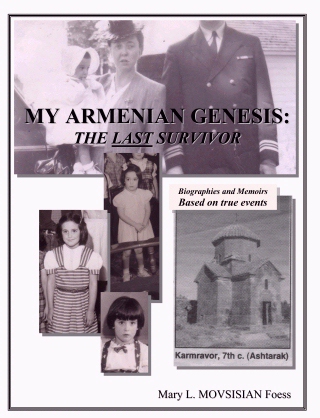
My Armenian Genesis:
The Last Survivor
by Mary L. Movsisian Foess
Lulu.com, 2010
Reviewed by Barbara Free
The author, an adoptee now in her 60s, began searching for her birth families in her 30s. Part of her story is her extreme concern with preserving or regaining her Armenian heritage, as most of her birth mother’s extended family had been killed during the Armenian Genocide (war with Turkey) two generations before the author’s birth, and those who survived came to the U.S., mostly in the Chicago area. The other part of her story is her complicated effort to obtain her sealed adoption records and to learn who her birth father was and connect with his family as well as her birth mother’s.
Her dogged persistence did eventually pay off, though with numerous negative consequences. She seems by her own report to have been absolutely obsessed with making these connections, yet her need to do so seems to have overwhelmed most of the relatives she located on her birth mother’s side, including her birth mother, an uncle, and a half-brother. Her birth mother spoke to her once on the telephone, but refused to meet her or to openly acknowledge her existence to her family, being still consumed with shame and grief. The uncle met her three times, each time because the author went to his house uninvited, and specifically disinvited. The younger half-brother, who appeared to have some serious problems of his own, had an on-again, off-again tumultuous relationship with the author. Sometimes he wished to be close to her, while other times he wanted to protect their mother, or the uncle, or himself.
On her father’s side, she discovered that he had died shortly before she made contact, but she did build apparently healthy relationships with two half-brothers and the widow of another. The birth mother and half-brother at one point claimed this man was not her father, that someone else was, but the author did find proof through letters that her birth father was who they had originally said, and again, the author’s persistence paid off.
Ms. Foess’s story is compelling, but for many readers, the length of the book will be discouraging before they read it. It is also difficult at times to tell if a quoted conversation actually took place, or is one of the author’s fantasies about conversations she wished could have taken place, or is one of her many dreams that she relates in detail. This becomes very confusing for the reader. There are also a great number of small details included in the writing which, while important to the author, seem irrelevant to the overall story, and to the reader. By eliminating many of these details, the book could be distilled into a more readable, still compelling (maybe even more so) story, and might be picked up by a mainstream publisher.
One of the major impressions this writer/therapist gained from the story, especially as it is currently written, is that the author’s extreme need for her birth family actually frightened and repelled several of them, which may be a reason many other reunion relationships do not develop well. Sometimes the searching person, whether adoptee, birth parent, or even sibling, is just too overwhelming, too eager, too fast, for the person(s) who are found to accommodate at first, and they back off. This may also be true of many relationships having no adoption connections. There is a great tension between a person’s sense of urgency and the fast passage of time, and the wisdom of building a relationship slowly, letting it evolve as it will over time. Reunited offspring and birth parents often try to make up for the lost years very quickly, resulting in disappointment, hurt and even fear, for all concerned.
This book could be read as a cautionary tale in that respect, but is probably better approached as simply the author’s account of her many adventures in a long and complicated search. Readers with an Armenian connection will read it from that point of view, while those with adoption connections will no doubt compare it to their own situations. This reviewer, who knows the author through telephone and written correspondence concerning her efforts at changing legal access to adoption records, hopes that she will continue to refine the book, so that the story gains the wider readership it truly deserves.
Excerpted from the October 2010 edition of the Operation Identity Newsletter
© 2010 Operation Identity