Movie Commentary
August Rush:
What Are the Messages?
by Barbara Free, M.A., LPCC, LADAC
The story follows the lives of two young musicians, Lyla, a classical cellist (Keri Russell), and Louis, an Irish guitar player and singer (Jonathan Rhys Meyers), who meet one evening on the roof of a New York City apartment building overlooking Washington Square Park and immediately fall in love, and the child they conceive after spending the night together (Freddie Highmore). As she hurries to leave after the lovers are awakened early the next morning by his band mates, Louis asks her to meet him at the park later that morning. When she doesn’t show up, he goes to the hotel where she is staying, only to see her being shepherded into a limousine by her irate father as he calls after her in vain.
When next we see them, Louis is leaving his band because of his obsession with Lyla, and Lyla is having the baby prematurely after being hit by a car. When she wakes up in the hospital, she is told by her father that the baby “is gone,” which she appears to interpret as meaning “dead.” The baby was, in fact, alive and surrendered to the custody of New York State by Lyla’s father, who forged her signature on the relinquishment papers, and placed in a county home for boys. The boy is never adopted, spends his life in this institution, complete with endless rows of bunk beds and other “lost boys.” He hears music in his head; the other boys call him a freak.
More than eleven years later, Lyla has stopped performing and is teaching music in Chicago; Louis has likewise abandoned his music and is living in San Francisco, apparently working in some financial capacity; and their child, is still living in the boys’ home.
Several things about this began to bother me as I watched. First, there seemed to be message that people can meet, fall in love and have sex and a glorious, enchanted courtship, all in a few hours, then not see each other again but spend their lives searching for each other, going about their lives in some sort of trance. Is this a healthy message for children, or for adults? The music contributes to the trance-like state of the viewer. The picture of the “home for boys,” of course, is totally unrealistic for this day and age, not only the 40 or so bunk beds, but the fact that this beautiful boy has never been placed with a family in all the time he’s been in the custody of the state. He is convinced that his parents just got separated from him and will find him again. This may be similar to the fantasies that many children in the foster system and some young adoptees have.
The boy has not been exposed to music in reality, has not played nor even seen musical instruments, and apparently knows nothing about them; only the music he hears in his head. When being interviewed by a new social worker (Terrance Howard), he appears never even to have learned to whistle! The social worker senses that something is special about this child and gives him his business card.
The boy says he does not want to be adopted, because then his parents might not be able find him. Then, he runs away, making it to New York City, where he was born. He is reported missing and pictures are posted, using his assigned name of “Evan Taylor” (nothing in the film explains why he has been given this particular name; the relinquishment paper, e.g., lists him only as “Baby Novacek”).
Somehow, he blends into the crowd. He spots a boy about his age playing guitar (not very well) for tips in Washington Square Park, and is taken in by him and some other boys, all of whom play music in public places, to live in an abandoned theater, where a middle-aged man called “Wizard” (Robin Williams) sort of looks after them and takes all their money each day.
Evan, discovering a guitar for the first time, immediately becomes an unorthodox but brilliant musician. Shortly after that, he wanders into a church/homeless shelter, where a little girl shows him a piano and plays a simple C scale, shows him the notes and lines in a piano book, and leaves for school. He is immediately composing full orchestrations, on paper, complete with the whole gamut of note values and markings (this part of story requires a massive suspension of disbelief). Then he is playing a large pipe organ (somehow in perfect shape in this church/shelter), immediately knowing how to use the pedals and all the keyboards and stops.
Having played piano and composed a little, and having little, very little, experience with a pipe organ, I found these scenes the most difficult to believe! Then, within days, he is discovered by Julliard and begins learning all the fine points of composition and conducting! The challenge is, he must escape from Wizard, who hopes to get rich off the child’s unusual talent.
In case the reader decides to watch this movie, I won’t give away the rest of the story, except to say that the mother finds out her child is alive and goes searching for him (in New York State, finding his name within a day or so is really incredible, given the laws in New York concerning search and closed adoptions, because although he was never placed, he was relinquished, albeit with forged papers).
What ought to be unbelievable, but isn’t, is that the girl’s father could forge papers and get away with it; that he would tell her the baby died and that she should go on with her life; that she tried to do so until, on his deathbed, he admits his forgery and deception. Those things do happen, although much more rarely than in the ’70s or earlier. Her loss, her yearning and eventual confession to a friend that she had spent the years looking at every child that would be the age of her son, her outrage at being deceived and deprived of her son—those all seemed very real and plausible. If only her being able to go to Social Services and find her child’s name and picture, with the help of that same young social worker, were believable, or even possible in New York, or most other states. The boy’s lifelong yearning for his birth parents, his sense that they wanted him and were connected with music, is believable. That he had spent his life in an orphanage, following his birth in 1995, is not believable, of course, given the strong demand for healthy Anglo babies. That mother, father, and son suddenly find each other and are instantly (and apparently permanently and flawlessly) bonded to each other again is not realistic, though it is the hope and fantasy of many adoptees, and many birth parents, for that matter.
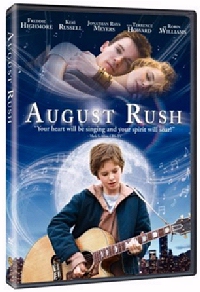
The blurb on the DVD cover says, “Your heart will be singing and your spirit will soar!” Because I am a birth parent, and a therapist, I felt no soaring, only sadness for the characters involved, including the homeless boy musicians and their de facto guardian, who had evidently been a street child himself. I was unable to suspend disbelief enough to enjoy the story as a fantasy, because the themes of loss and relinquishment are more powerful to me than the magic of the music and reunion.
I cannot help wondering what messages my grandchild is getting from this movie, both consciously and unconsciously. That magic is possible? That parents can lose you and each other? That kids are capable at the age of eleven of surviving in a huge city? That children will always know what’s right or best? That a relinquished child will find his parents? That there are still orphanages with rows of bunk beds? The conscious appeal to her is the music, I am sure. As the boy says, “The music is everywhere. All you have to do is listen.”
My granddaughter loves music, and children love to see other children in movies. But the messages she may be absorbing from this movie are powerful, and I hope I can discuss this with her as she grows up and figures out that her uncle, my eldest son, was relinquished, although not to an orphanage, and that we were reunited, though not in Central Park, and not with his birth father. How might this movie influence her view of me, her grandma, when she realizes I relinquished her uncle? The boy in the story says, “I believe in music the way some people believe in fairy tales.” I would have to say I believe in music, but not in magic.
The media are full of stories about adoption, relinquishment, loss, and sometimes reunion. Most of us hope for happy endings, just as we have hoped for happy endings (or new beginnings) in our own lives, but hoping to magically be found and reunited is probably not very healthy or productive. Reunion in the real world takes work, usually takes time, and always is an ongoing process, not just one magical event.
We invite feedback from those who have seen this film, as some may have quite different reactions to it than I. We’d particularly like to learn how adoptees, birth parents, and adoptive parents might view it differently.
Excerpted from the January 2009 edition of the Operation Identity Newsletter
© 2009 Operation Identity