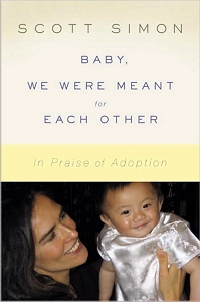
Baby, We Were Meant for Each
Other:
In Praise of Adoption
by Scott Simon
Random House, 2010
Reviewed by Barbara Free,
with Nina Stephenson
Scott Simon is the principal host of National Public Radio’s Weekend Edition Saturday program, and he has always seemed to be a rather serious, measured reporter and interviewer. It is clear he loves his daughters, to the point of absolute infatuation. The girls are still quite young, and neither they nor the parents have yet experienced many serious problems together. Perhaps, in ten years or so, Simon would write a different book, and his daughters might have their own opinions then.
This reviewer first heard of the book in an interview with the author on NPR. He seemed a bit over the top, but did acknowledge that he and his wife can only view parenting through the lens of their own limited experience. They have no birth children, hence nothing with which to compare their experience of traveling to China to bring back first one daughter, and on a subsequent trip, the other. The process apparently went relatively smoothly for them, although it did take time, in spite of Scott Simon’s relatively “advanced” age (China has since put more restrictions on adoptive parents’ ages, marital status, sexual orientation, and other details). Perhaps it was somewhat easier for the Simons, financially, than it was for many adoptive parents. That said, the adoption process and the Simons’ life as an adoptive family seems to be portrayed as just almost too lovely to be true, almost euphoric much of the time.
An early clue (to this writer) to a lack of connection with the larger adoption world was that none of the endorsements on the book jacket were from anyone with known adoption connections, but were from actors and people this writer never heard of. Although at the end of the book, he mentions getting together once a year with other families who got their daughters the same day at the same place, there is no other indication of ongoing involvement in adoption circles. They have made an effort to maintain the girls’ connection to Chinese culture, language, and people, which he initially thought was not so necessary or important until a young Chinese woman who was babysitting told them how fortunate the girls were to have each other as sisters, since so few do, due to China’s one-child policy. Simon talks about how inhumane that policy is, yet that is why he was able to adopt his daughters. They do intend to help them find their birth mothers later.
At times he speaks lovingly of these “mothers who gave them life,” but at other times makes assumptions about “abandonment” and the old saw that adopted children know they are wanted and loved because they were “chosen.” He also has “testimonials” from adult adoptees who are “glad” they were adopted, with little balance. We think perhaps this was the author’s way of shoring up his hopes that in the future his daughters would also be “glad” they were adopted.
I kept hoping that he would, on the next page, get into the real meat of the book, but he never did. Again, knowing his expertise at interviewing and reporting, I was surprised and somewhat dismayed. The title phrase, “meant for each other,” seemed, again, his fond wish. It completely ignores the existence of birth parents. Were these little girls not meant for their birth parents?
Thinking that, as a birth parent, I might be too attuned to the grief of birth parents and adoptees and not to the joy of adoptive parents, I asked Nina Stephenson, mother of a daughter from China (now a teenager) to read the book and review it. Here are her comments:
Scott Simon’s book is touching as a loving tribute to his young adopted daughters. As I read the book, however, I wondered how much he had thought about the larger context of adoption—the heartbreaking decisions made by birth parents, the loss of birth family ties felt by most adoptees, the loving guidance required of adoptive parents as they help their children navigate their complex emotional feelings. While Mr. Simon makes passing reference to these and other issues, I found this book to surprisingly superficial, given the author’s stature and intelligence.
We are interested in the thoughts of others who read this book, including adoptees, both young people and adults. It was not in the new releases at the book store, but was later found in the parenting section, so readers may have to look for it. It will be available to O.I. members through the O.I. Lending Library.
Excerpted from the January 2011 edition of the Operation Identity Newsletter
© 2011 Operation Identity