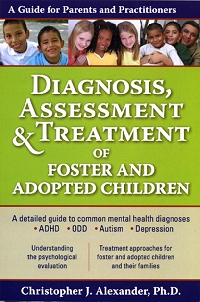
Diagnosis, Assessment & Treatment of Foster and Adopted Children:
A Guide for Parents & Practitioners
by Christopher J. Alexander, Ph.D.
Christopher J. Alexander, Ph.D. & Associates, 2009
Reviewed by Barbara Free, M.A.
The author, a local child psychologist who presented a workshop at the AAC Southwest Regional Conference in Albuquerque in 2000, has authored a previous book and many professional articles. This book would be helpful for every professional who deals with children in the foster system or who have been adopted through the foster system, and probably would be of value for any other therapist, because all therapists encounter adoptees and persons who have been in foster care, whether they acknowledge that or not. Prospective adoptive parents, particularly those who are planning to adopt through the foster system, or adopt any child beyond the age of a few days, really ought to read the book.
Although Dr. Alexander is writing about children who have been traumatized by their early life and/or the foster system, he does not over-pathologize them. His approach about attachment, for instance, discusses how children develop problems because adults have failed to attach to them, not the other way around—when children have attachment problems, it may have been self-preservation. He seems to have a balanced approach, not accepting the idea that every adoptee or foster child will have problems, but also not discounting the fact that adopted and foster children, overall, do have higher rates of special needs.
He also gives some good guidelines for how parents evaluate possible treatment approaches or programs for their child. There are some treatment methods and some centers and practitioners who have radical, possibly even harmful, methods. He talks about how parents can help their children, reminding them that one does not just turn the child over to a therapist or treatment center and then get back a magically healed, perfect child, with no effort (only money) on the part of the parents. He states that having “structure” does not mean running the home like a military camp. He does not advocate that all, or even very many, children be medicated, while saying that in some instances it is helpful. He sees children as real human beings, not “cases” or problems.
This is a valuable new book that probably ought to be bought and used by more professionals and parents than it probably will be. It is highly recommended.
Excerpted from the October 2009 edition of the Operation Identity Newsletter
© 2009 Operation Identity