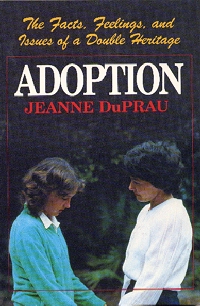
Adoption:
The Facts, Feelings, and Issues
of a Double Heritage
by Jeanne DuPrau
Julian Messner, 1990
Reviewed by Barbara Free, M.A., LADAC
Although many readers who have been involved in search and reunion circles and adoption support groups for some time will not find new material in this book, there are far more individuals and families for whom the idea of search and reunion, let alone open records or open adoptions, is a whole new and strange world. Some believe records have always been sealed everywhere, and that only closed adoptions, through agencies, have always been the only way to adopt. Others, including many professional therapists, have assumed that anyone could have access to their own records, at least as adults.
The idea that birth parents might also want access, or want to search, does not occur to many more people, who assume it’s only adoptees that ever want to search, or should have the right. Even the author of this book focuses mainly on the adoptee, to a lesser extent on the adoptive parents who oppose search or open records, and only briefly addresses the thoughts and feelings of birth parents. When the issues of birth parents are mentioned, the impression is left that about 50% are open to reunion or want to search, although the author does state that only about one out of a hundred refuse reunion if located. The reasons given for refusing, according to this book, are mostly that the birth mother has a great marriage and other children, but the new family knows nothing of the relinquished child, and if they were to find out, “It would be the end of my marriage and he would get custody of the children.”
As a reunited birth mother with several children, and a husband, this writer and therapist questions how “wonderful” a marriage could be where one partner has been keeping such a huge secret the entire time, apparently in great fear, and wonders how wonderful this partner is if he would abandon her for having had a child before he was even in the picture. Unfortunately, the book does not address this.
Nevertheless, this rather small book can provide some facts and issues for open discussion in families where search is a possibility or a reality. It also might be a good beginning bock for those considering adoption, as it discusses some of the issues of open vs. closed, infant vs. older child, etc.
There is also the assumption, unfortunately, that most people want to adopt a “healthy white infant,” as if that is one word, “healthywhite.” This also assumes that potential adoptive parents are also all white. These assumptions bothered this writer, but may not be so big for readers new to various adoption issues.
The book opens with stories of two adult adoptees, one of whom found out he was adopted somewhere during his childhood (not really early), but was discouraged from searching until after his adoptive mother died, and the other story is about a woman who did not know she was adopted until after her adoptive mother died. Interestingly, this woman was black, adopted by black parents. The Epilogue again mentions these two persons, and says that Operation Identity helped her find her birth family by going to court. Operation Identity is not previously mentioned in the book!
In short, this is still a valuable book for beginners, and a good resource for professionals, who are not in the adoption field, to have available. An updated revision, with more information about birth parents and the current ideas about open records and open adoption, along with states that have opened their records to some degree, would be even more helpful.
Excerpted from the April 2009 edition of the Operation Identity Newsletter
© 2009 Operation Identity