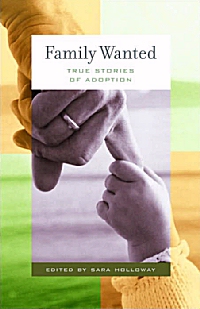
Family Wanted:
True Stories of Adoption
Edited by Sara Holloway
Random House, 2005
Reviewed by Marilyn G. Roy
Taking into consideration not only that she is writing as an author for the first time, but that she is compiling an anthology on a subject with which she has no previous experience (she is not a triad member), Ms. Holloway has produced a powerful and moving book that easily takes its place among the best of adoption literature.
The book is divided into three section: “Children,” “Parents/Birth Mothers,” and “Parents/Adoptive Parents.” Ms. Holloway states that all but two of the selections are non-fiction. She also began the project with a list of authors whom she had known to be adopted, thinking that “...the conjunction could lead to some interesting and moving...” stories. She may not have known authors that were birth parents, or not known that about them. Upon examination, I discovered that all but one of the 25 contributors had some connection to the publishing industry; 22 are writers by profession or hobby. The result is storytelling that is, by turns, difficult to read for the intensity, humorous, ironic, sad, or warmly portraying characters and circumstances. The writing, almost without exception, is rich and intelligent, written with a depth of sensitivity not always found in this genre. With a birth mother’s nervous curiosity, I scanned the stories for children relinquished at birth, relinquished as young children or older, and found that most of the adoptions had occurred within the child’s first year of life, at least seven within the first week. I thought this important to consider when reading the section, “Children,” written by now-adult adoptees. This section has the greatest number of stories, among them two which I’ve called the “worst” (Robert Dessaux’s “Shaping Up,” for both the complexity of his writing style and almost toxic negativity), and “hardest to read” (Jonathan Rendell’s “Oedipus Descending,” due to the unfortunate picture drawn of the birth mother).
C. Lindsey Sagnette’s “Our Vocabulary,” about the closeness of a family whose two daughters were both adopted, was one of the best. If there is a weakness in this book, it is that there are only four stories from birth mothers, and none at all by birth fathers. None of these were particularly easy to read, but I found the most uplifting (at the end) to be Lynn Lauber’s “A Love Diverted.” Among the stories from adoptive parents, there is a surprising predominance of international adoptions. Perhaps that is not surprising, since the numbers of children from other countries, especially China, finding homes with American parents has been on the rise in recent years. Each of these stories held my interest from start to finish, as I learned of the amazing tenacity of of parents whose babies might wait months in orphanages or foster homes for all of the bureaucratic hurdles to be cleared. Of these, Matthew Engel’s “My Daughter’s Big Brother” was not only my favorite, but also received my “best in the book” award for the remarkable story itself. The tension builds with each turn of the page, as the reader wonders how much more this couple will have to endure before they finally can take their child home. The writing is somehow calmly objective while still conveying the frustrations of two loving people who are dealing with one unexpected trial after another in an unfamiliar country.
Overall, I would rate this book as highly readable, for both content and quality of writing. Some might hesitate to read it because of perceived differences in adoption experiences between American and British systems. However, after the first page, such differences, if they exist, soon fade away. As with any good story, we keep turning the pages, eager to know just how each story will turn out.
Marilyn Roy is a writer and reunited birth mother who lives in Lawrence,
Kansas. She periodically reviews books for this newsletter.
Excerpted from the April 2008 edition of the Operation Identity Newsletter
© 2008 Operation Identity