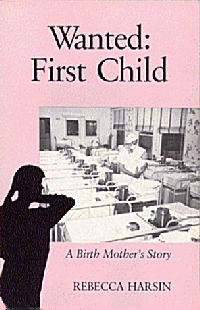
Wanted: First Child:
(A Birth Mother’s Story)
by Rebecca Harsin
Fithian Press, 1991
She was repeatedly told that her desire to keep her child was selfish and that she would forget she ever had the baby, if only she would do the “right thing” and relinquish her daughter. She steadfastly refused, but was finally pretty much forced into it by her mother. This is such a common story that casual readers might think “Oh, that’s the same old story. What’s new?” But to any birth mother, it is painfully real story.
The author went back to school, later married and had three more children, and was considered a “good mother,” but, of course, she never stopped grieving f that time or her first-born, and always told herself she would find her when the girl turned 18. When arrived, in 1988, she began to search. She had a good marriage and peaceful life with her husband and three children, but she had always known she could not feel complete until she found her first child.
By that time, search and support groups were beginning to form across the country, and she began to get in touch with some, and later co-founded one herself. Her mother, who had been so adamant about her relinquishing her daughter at birth, was now supportive of her search. What the author still did not know about were the family secrets concerning pregnancy and adoption in her father’s family, which had influenced her mother’s and her paternal grandmother’s insistence that the author could not keep her child.
She does ultimately have a happy and successful reunion with her daughter and her daughter’s adoptive family. The real twist is in her learning those family secrets and helping her father achieve his own reunion.
This book is a good one for persons who are considering searching, or are at the beginning of a search. It is not long or difficult reading, and does have a positive outcome. Birth mothers may identify with the author and her story, adoptees may find encouragement in her continued love for her daughter, and in the successful reunion, and adoptive parents may find good role models in the daughter’s adoptive parents, as well as a deeper understanding of the birth mother’s and adoptee’s experiences.
O.I. Member
Excerpted from the April 1999 edition of the Operation Identity Newsletter
© 1999 Operation Identity