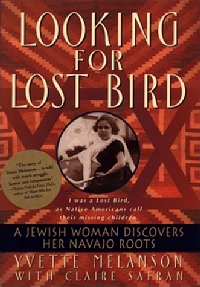
Looking for Lost Bird:
A Jewish Woman Discovers
Her Navajo Roots
by Yvette D. Melanson
Avon Books, 1999
Reviewed by Kathy Forward
Yvette discovered over the years that she was born to Betty Jackson and Yazzie Monroe in 1953 in Tolani Lake, Arizona, and that she was a twin. Born at home, she and her twin brother were taken to the IHS Hospital in Winslow in a few days, as she appeared ill. The parents were told to leave both babies. When they came back, the babies were gone, and someone had severed their parental rights. The babies had been literally stolen, with the hospital’s complicity. Apparently, they were taken to Ft. Defiance, then to Salt Lake City, and Yvette (then Minnie Bob) was taken to Florida. It was there, at the age of three, that she was picked up at the Fountainbleau Hotel by the Silvermans and taken to New York.
Her life after that went well, with loving adoptive parents, who gave her the advantages of a middle-class Jewish life, until her adoptive mother, Beatrice, became ill and died when Yvette was twelve. By the time she was 14, Larry Silverman remarried, to a woman named Blanche who despised Yvette, for reasons she does not know. She was sent to a boarding school and not allowed home, even for vacations, and was nearly homeless by age 16. At 18, just out of high school, Blanche and Larry sent her to Israel, where she joined the Israeli Army for two years and fought in the Yom Kippur War. The day she was to marry a young man there, he was killed.
When she returned to the States, she joined the U.S. Navy, briefly married and had a son, Brad, who she later lost to the court system. A few years later, she married an older man named Dickie Melanson, an alcoholic who eventually found recovery. They had two daughters together.
In 1995, Yvette bought a computer and soon started looking for her history. She had no knowledge that she was Native American, and with light hair and green eyes, did not suspect it. Looking under adoption.com, one of her postings attracted the attention of Sue Stevens, of the Lost Bird Network, seeking to find Native American adoptees who had been lost from their Native families. Through this network and other postings, she was connected with a woman in Arizona, Lora Chee, searching for her lost twin siblings. In the papers given to Yvette by her adoptive father, she found dates that matched, and a number, which turned out to be her Navajo Census Number.
After finding her birth family (her mother was deceased, but father still living), Yvette and her husband traveled to Arizona to meet the family in person, and ended up moving to Tolani Lake with their daughters. Still there, they have embraced the Navajo life, which was not easy for Dickie and the girls, particularly. She even learned to weave and started a company to market her family’s art.
The book spends a lot of time comparing Navajo and Jewish beliefs and spiritual practices and their meanings, and how Yvette has integrated all of them for herself. It also details the search to find her twin brother, which she eventually did. Yvette has been overwhelmed by her family’s acceptance of her, and surprised by her ability to change her life and become part of the Diné way of life. The book reads almost like a Tony Hillerman novel, a can’t-put-it-down story with many twists and turns.
Last November, a Hallmark Hall of Fame television movie, The Lost Child, was based on Looking for Lost Bird. The book has many more details, of course, including her life in Israel and the search for her twin, who was found in Ohio. We highly recommend it for enjoyable reading, as well as learning some about what happened to many Native American children in the past.
Excerpted from the April 2001 edition of the Operation Identity Newsletter
© 2001 Operation Identity