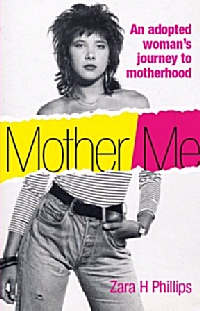
Mother Me
by Zara H. Phillips
British Association for Adoption & Fostering, 2008
Reviewed by Barbara Free
Ms. Phillips, an adult adoptee, writes very openly about her thoughts, feelings, and behaviors as a young child, adolescent, and adult. Unaware of Britain’s open-records policy, she did not know she could search for her birth family, or that she had the right to do so, until a friend urged her to do it. She recounts her life story, her emotional problems, her relationship with her brother, who was also adopted, her relationships with her adoptive parents and grandparents, and her extensive and complicated relationships with various substances from tobacco and marijuana to cocaine and whatever was available, as well as unhealthy relationships with friends and lovers. For some long years, her chemical relationships seemed to be her primary ones, as she tried to anesthetize, enhance, or otherwise alter her feelings and perceptions. Such attempts to control what feels so out of control are probably no more common among adoptees than in the general population, but the underlying sense of loss and lack of authentic self-concept may be more acute in adoptees. Ms. Phillips expresses this difficulty eloquently, in ways that will cause many adoptees of all ages to say, “That’s exactly how I thought and felt, and still do.” Many will find that affirming in a very deep way. Others with adoption connections will find her words compelling and informative. Much of her story is harrowing, but her offhand style of expression does not lead the reader to pity or sadness as much as to hoping that this person will finally find herself and quit being self-destructive, which she ultimately does. She does seem to have an extremely long adolescence, as she herself admits. Her recovery from chemical dependency, which she also describes very openly, helps her become a psychological adult at last. This reviewer has been an addiction therapist many years, and the author’s story is authentic. It would be helpful for many addicts, whether they have adoption connections or not. In fact, the author has informed us that she has recently presented on both her adoption and her addiction at conferences.
She seems never to have had a close relationship with either of her adoptive parents, and the reader does no get much of a picture of them as persons, which seems significant. She does not make the close connection with her birth family for which she had hoped, either, perhaps because she had still not really bonded with herself as an authentic person. Later, as she progresses in recovery, marries and has children, she is able to do this at last, and becomes closer to her adopted family, her birth family, as well as her spouse and her own children. She describes how terrifying it was at first for her to change her lifestyle when she got sober. Her friends said, “Just give yourself some time out to get to know yourself. We promise it won’t kill you.” She says she was “stuck, trapped, dependent on outside sources for any sense of self-worth.” As she changed her behavior, her wardrobe, and her friends, she began to change her perceptions of herself.
This is a “can’t-put-it-down” book that deserves a wider readership than it may get, due to not having a major publisher. It would be helpful for anyone in recovery from chemical addiction, relationship addiction, or from growing up in a painful, disconnected family as well as for those who have been adopted, who relinquished a child, or adopted a child, or married someone with adoption connections.
The author currently lives in New York, is married with three children, and was a presenter at the recent AAC Southwest Regional Conference in Sacramento. O.I.’s Bill Gage met her there and talked with her at length, and donated the copy of her book he purchased from her at the conference to O.I. She states in an e-mail since then that she just got a book deal with a U.S. publisher, and will be updating the book again. We look forward to continuing to learn more from and about her.
Excerpted from the July 2010 edition of the Operation Identity Newsletter
© 2010 Operation Identity