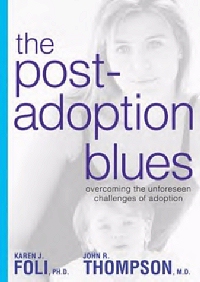
The Post-Adoption Blues:
Overcoming the Unforeseen Challenges of Adoption
by Karen J. Foli, Ph.D.
and John R. Thompson, M.D.
Rodale Press, 2004
Reviewed by Barbara Free
However, this book is very incomplete in some areas. It lists several books for suggested reading, yet none of those books are by or about birth parents in any way, and none address the whole picture of the adoption triad. One would have expected to at least see Dear Birthmother, The Other Mother, Lost and Found, The Primal Wound, The Family of Adoption, Journeys After Adoption, Stories of Adoption, and Adoption Nation. The book also lists some adoption-related organizations and magazines, but does not mention the American Adoption Congress. Surely these books and the AAC would be part of a well-rounded referral list? They do list the National Adoption Information Clearinghouse, which would probably lead to AAC and the above-mentioned books.
The book does discuss birth mothers—and even birth fathers—in positive ways. The main thrust of the book is that adoptive parents, like some birth parents (not necessarily relinquishing parents) may experience some dismay, anxiety and even depression following their adopted child’s arrival. They list several common but unrealistic expectations parents may have, both about the child and about themselves, but also about the support they will receive from society, family and friends, and from professionals. That is a very valid point—appropriate support often disappears after the child arrives. Perhaps people expect that parenting an adopted child is no different, maybe even easier, than recovering from childbirth and taking care of a newborn. Perhaps people think that adoptive parents want to forget the child is adopted and so don’t want any extra attention. Families, friends, and adoption agencies would do well to heed some of the material presented in this book
Additionally, although postpartum blues may have an hormonal component for a birth mother, post-adoption blues is lacking in a positive hormonal component, in that the adoptive mother is not producing prolactin, except in those cases where an adoptive mother breast feeds a newborn adopted baby. She may expect to have motherly feelings automatically and is dismayed and upset when that does not happen. Adoptive parents also do not see themselves physically mirrored in their adopted child, because the child does not resemble them in physical detail. The fact that the child might be older than a newborn, and/or of a different ethnic background often plays a role in this, no matter how much parents or society wish to deny it. Even a birth child who looks distinctly different from a parent may cause a different, or delayed, type of bonding from one who looks “just like me.” The authors do not address these issues in depth as much as they do the fact that children adopted internationally may already have histories of behaviors and expectations that the adoptive parents don’t know or aren’t prepared to handle.
In summary, this is an excellent book for prospective adoptive parents, and possibly for prospective relinquishing birth parents, as part of an overall reading and discussion plan, and should be read by adoption professionals. It is available in the Operation Identity lending library for checkout.
Excerpted from the October 2005 edition of the Operation Identity Newsletter
© 2005 Operation Identity