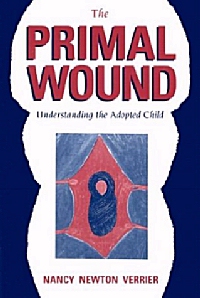
The Primal Wound:
Understanding
the Adopted Child
by Nancy Newton Verrier
Gateway Press, 1993
Like many of us, Verrier, an adoptive mother, teacher, and therapist, believed love could conquer all when she and her husband adopted a three-day-old infant girl. Her parenting experience led to ten years of research to understand the complex dynamics of the adopted person. Such behaviors range from testing and acting out to compliance and withdrawal. All parents of teenagers face these adolescent challenges, but adoptees carry a tangled web of issues superimposed on the usual stages of growth and development that plague us all.
While our society and many potential adoptive parents view adoption as a panacea for unwanted children, Verrier helps us see the deep wounding and pain that festers and grows inside the adopted person. In alcoholic families John Bradshaw coined the term “the hole in your soul” for similar pain. This pain—or primal wound—is physical, emotional, psychological, and spiritual. We are now learning the pain operates at a cellular level and is a part of the energetic system of the mother and child. Relinquishing a child severs their tie and leaves indelible marks on both mother and baby.
In Part I, “The Wound,” she describes how the wound results in a loss of self-worth and a tendency to mistrust the permanency of relationships. As an adoptee, my own low self-esteem as a young adult and need to test my husband’s commitment to me in marriage are clear indicators that this invisible wound exists. As Verrier describes, we all pass through the stages of grief, perhaps many times over, but to an adoptee the grief can be endless.
In Part II, “Manifestations,” the author describes the core issues for all adoptees: Abandonment and loss (that manifests as rejection), trust, intimacy, loyalty, guilt and shame, power and control and finally, identity. Some would tell us that all human beings and family systems share these challenges in life’s journey. Why are adopted people unique?
Denial and myth surround adoptees from the day they are born or perhaps while in utero. We now know from Verny and Kelly’s work, The Secret Life of the Unborn Child, that the Mother-Baby bond is established in the early stages of pregnancy. Imagine then the negative energy and/or anxiety and depression surrounding an unwanted and unplanned pregnancy. The baby is surrounded by this energy. The grief is profound. The challenge for all triad members is to distinguish those dynamics related to the primal wound from the challenges of coping in the real world. Clarifying these issues can feel like trying to fly an airplane through a glass of milk. It’s not easy!
In Part III, “The Healing,” our author guides us to think about whether adoption is to be avoided for all its messiness, or if not, what can be done differently? The medicine pouch of healing includes understanding, acceptance, empathy, and communications. The “Reunion Process” can have a powerful effect on healing when expectations are realistic and everyone learns reunions are not one-time events.
The same coping skills we use to deal with life’s changes are useful for adoptees to apply when beginning this healing journey. The ability to understand paradox, to view the many colors of the adoption rainbow, not simply see life in black and white or right or wrong, are essential skills to hone. Beginning to accept that perception shades all reality and is a fundamental skill for all triad members to develop. Verrier moves on to describe the ways adoptees can empower themselves while reminding us of the barriers, namely: fear, guilt and shame and, finally, anger. Finding a spiritual path can be a useful addition to one’s medicine pouch of healing,
The writer concludes by sharing questions put to her during her years of research into The Primal Wound where she discusses the implications of abandonment on other populations, step-families, fetal alcohol syndrome and more.
This is a painful book to read. Yet, it is only by walking through the pain of grief and loss that we are able to heal ourselves. This is a book that should be read in small doses, leaving time and space for contemplating how its messages speak to your heart. It may make you cry, but you will know that you are not alone in this journey and I guarantee you will want this book on your shelf for a lifetime!
Adoptee and Adoptive Mother
SW Regional Director, AAC
Excerpted from the October 1999 edition of the Operation Identity Newsletter
© 1999 Operation Identity