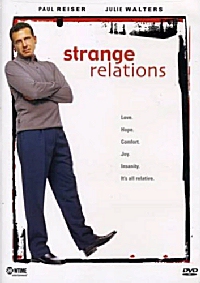
Strange Relations
Written by Tim Kazurinsky
Directed by Paul Seed
Starring Paul Reiser, Julie Walters,
Olympia Dukakis, and George Wendt
A Showtime Original Production, 2002
Reviewed by William L. Gage
As the film opens, Dr. Jerry Lipman (Reiser), a 39-year-old psychiatrist, is obviously having trouble staying awake during many of his patients’ sessions. When he describes his symptomology to one of his patients, who happens also to be a physician, he is soon diagnosed with an imminently fatal case of leukemia. The prescribed cure—a bone-marrow transplant—requires a closely related donor, preferably a full sibling, of whom, unfortunately, he has none.
When Jerry tells his mother (Dukakis) that he has leukemia, this prompts her to reveal to him—apparently for the first time in his life—that he was adopted when he was two days old, when his father was working in England. She is able to tell him that his birth mother was a Catholic girl from Liverpool named Sheila Burkeman, but little else about his background.
Problems in dealing long distance with the British adoption bureaucracy in an effort to get his identifying information (to which he is legally entitled under British law), as well as the hectoring of his best friend (Wendt), prompt him finally to go to England to get his birth and adoption records. (The depiction of the British bureaucrat will probably prompt rueful laughter among those of us who have had to deal with such entities in the course of a search.)
Jerry obviously has a close relationship with his adoptive mother, as it is her he calls when looking for advice and encouragement before actually confronting his birth mother where she lives, in a Liverpudlian neighborhood that he describes by saying that it “aspires to be a slum.”
The initial confrontation is brief, but emotional. Sheila Burkeman (Walters) (now known as Sheila Fitzpatrick), after initially denying the truth once he has told her who he is, suffers a fainting spell. The explanation of why he was surrendered is stereotypical: she was a poor, unmarried, 16-year-old, Catholic girl, who ultimately married “Denny” Fitzpatrick, the man she identifies as having been his birth father; and Jerry’s comment of, “That’s great!” when she tells him they had two subsequent children reminds us of the movie’s principal dramatic thrust—Jerry’s need to find a compatible sibling to be a bone-marrow donor.
In the course of this initial meeting, Jerry also meets Maureen, the wife of Derrick—one of his two brothers and the “black sheep” of the family—who lives with Sheila with her two children, who also meet their “new uncle Jerry” when they come home from school in the midst of it all.
Initially, Jerry doesn’t want to tell anyone why he has come back into their lives for fear of their reactions, and much of the middle portion of the film deals with the process of Jerry’s getting to know these new, sometimes very “strange relations,” while also trying to get blood samples from his two brothers to test for compatibility without letting on to them what he is up to; as well as hiding his illness from all concerned—a feat made all the more difficult when Sheila insists that he move from his hotel into her home.
It is clear—once she is past the initial shock—that Sheila is totally welcoming of her long-lost son, and many of us will envy Jerry Sheila’s unconditional motherly acceptance of him upon their initial reunion—if not the circumstances that precipitated it. Sheila even arranges a big party at the local parish club to introduce her returned—albeit adult—first-born child to her friends and extended family, who are comprised of a number of even “stranger” relations.
The film’s title seems apt enough, but “strained relations” might have been even more appropriate. Both of his brothers have less-than-perfect relationships with their respective spouses: Frank is a large, doughy-faced man, who is henpecked and thoroughly cowed by his wife, Mavis; while Maureen’s husband, Derrick, is a wiry, spike-haired, disheveled and drug-addled ne’er-do-well, who lives apart—and unfaithfully—from his wife and children. However, while the course of Jerry’s reunion isn’t always smooth sailing, Sheila never ceases to reaffirm her love for her first-born child, and remains the voice of reason and the emotional anchor of the family.
Of course, the cat finally gets out of the bag, putting a strain on the budding romantic relationship between Jerry and Maureen, and Jerry ultimately finds out that neither of his brothers is a compatible donor. He returns, despondent and fatalistic, to his home in New York, saying goodbye only to Sheila—leaving Maureen to assume the worst about his motives—both for becoming involved with her and for leaving when he does—and the viewer wondering how he will find his inevitable “happy ending,” especially after he is advised by his doctor following his return to New York that he probably has only a few months to “get his affairs in order.”
When Sheila realizes during a subsequent telephone call with Jerry that he isn’t going to be coming back for any more visits, she decides to sell all of the gifts he has sent her and her family to buy airfare to New York for herself, Maureen and the children for a surprise visit. Maureen and Jerry finally achieve a rapprochement, and Sheila vows to stay by his side to the bitter end, despite Jerry’s request to the contrary—until she is forced to reveal an even darker secret from her past than having given up a child for adoption in order to save her son’s life.
The story is played as much for laughs as for pathos—both Reiser and screenwriter Tim Kazurinsky are best known for their comedic turns on the small screen—causing one to laugh one minute and be moved to tears the next; and the resolution has a satisfying neatness that I felt was neither forced nor contrived, but rather based upon a circumstance with which some adoptees or birth parents may be able to identify.
The final scene between the three triad members—birth and adoptive mothers and adoptee—is particularly moving, and should leave no one doubting that they do manage to get past this major crisis to enjoy the opportunity to develop an even closer relationship.
The foregoing originally appeared in the Autumn 2002 issue of Geborener
Deutscher, and is reprinted here with permission. Strange Relations
may still be seen from time to time on the Showtime cable channel, and
is also available on DVD.
Excerpted from the July 2003 edition of the Operation Identity Newsletter
© 2002 William L. Gage