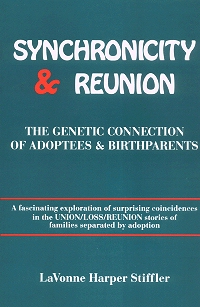
Synchronicity & Reunion:
The Genetic Connection of Adoptees & Birth Parents
by LaVonne Harper Stiffler
FEA Publishing, 1992
Reviewed by Barbara Free
This book is a valuable resource for triad members considering searching for their family members, or for those involved in the search, or shortly after initial reunion. The many quotes and anecdotes are probably the book’s greatest strength, and the part that most readers will really enjoy.
Stiffler recounts many examples of synchronicity, of reunited persons discovering what they have in common, including names, doing the same things at the same time, preferences they didn’t expect to have, similar careers, similar health problems, etc. Some of these are expected genetic similarities, such as physical characteristics, but some are not so easily explained, such as marrying spouses with the same given name, searching for each other at the same time without any knowledge of the other’s searching, and significant dates that are shared.
Woven in with the quotes and anecdotes are excerpts from various research studies of adoptees, birth parents, and reunions, and psychological theories and philosophical models. At the beginning of the book, Stiffler likens the mother-child relationship to a Mobius band, a never-ending band with one turn in it. She mentions this analogy again toward the end of the book, but doesn’t develop it much more than that. She quotes Carl Jung regarding synchronicity, intuition, etc.
One of the problems I had with the book is that empirical research and facts are mixed not only with anecdotes, but with pseudoscience, such as extrasensory perception and psychic phenomena, without distinguishing between these approaches, sometimes presenting conjecture as objective research results. Sometimes Stiffler and her subject see significance where there is probably really only coincidence, much like fortune-telling. For me, that detracts from the very real value of her research. However, the many anecdotes and examples from the twin studies, particularly the one in Minnesota, are enough to make the book worth reading.
While I wouldn’t take seriously her idea that one generation of behavioral changes creates actual permanent DNA changes, I don’t deny that a crisis in one generation does set one’s life and descendants on unexpected paths, that cannot always be explained rationally. Connections between separated parents and offspring, and siblings, do seem beyond chance, cannot be physically proven or disproven in the way that similar eye color, blood or tissue type or handedness can. Perhaps in the future some of these connections will be empirically explained through genetics, or prenatal influence. Others probably acquire significance for individuals because they want to see significance. Statistics on chance and probability are of less value than people’s desires in these cases. While I wouldn’t recommend using this book as a scientific resource, I would recommend it as good reading for triad members for its thought-provoking value, and even just entertaining value. For someone considering search or involved in a search, it will provide some motivation for finding one’s own connections and synchronicity.
Excerpted from the January 2009 edition of the Operation Identity Newsletter
© 2009 Operation Identity