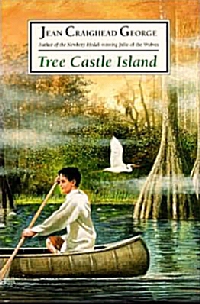
Tree Castle Island
by Jean Craighead George
HarperCollins Publishers, 2002
Reviewed by Jenna Wiley and Barbara Free
The story is set in the Georgia portion of the Okefenokee Swamp, in the Southeastern United States. The author did her research very well, with lots of facts about plant and animal life in that region, and social customs. The protagonist is a fourteen-year-old boy, who decides to explore the swamp in a canoe he had made himself, while his parents are gone on a trip to Europe and he is officially under the care of an “uncle,” a local outdoors man with whom he has spent much time, and from whom he learned about the woods and swamp.
In the course of his adventures and misadventures, he first discovers a dog that looks like his own and answers to the name Dizzy, the same name as his own dog. Later, he meets the dog’s owner, a boy who looks just like him. The other boy knows he’s adopted, while our main character has never known he was adopted. This discovery happens about halfway through the book, and during the rest of the book, he confronts this new reality and all its implications, and ultimately confronts his adoptive parents as well, asking why he was never told.
As previously stated, this book is well-written, with a large vocabulary and lots of interesting facts about plants and animals. Jenna discovered this book in the school library where she works. After reading it, she recommended it to a number of students, and asked for their comments after they had read it. Out of about 25 middle-school age students, nearly all of them thought it unrealistic that a fourteen-year-old would be allowed to go off on his own; thought it would be impossible for adopted twins to ever find each other, but did not think it unusual that one had never been told he was adopted; and further, these students did not see adoption as a major theme in the book. Part of this may be the cultural difference between urban New Mexico life and rural backwoods Southern life, as far as the freedom to go off on one’s own. It also shows that most kids of this age are not familiar with adoption issues or current adoption customs. It might be interesting to have adolescent adoptees read this book and give their comments, or even adult adoptees.
As soon as we obtain a copy of this book for the O.I. library, give it a read and write down your comments. After Jenna’s enthusiasm, Barbara read it and found it a can’t-put-down-until-it’s-finished story. We don’t know what the author’s experience is with adoption, but she certainly has experience with the swamp. Her use of description is unusually beautiful, another aspect often ignored in books for this age group. The adoption situation she portrays in the book is an informal private placement, which is perhaps not as unusual as most adoption publicity would lead us to believe.
The reviewers aren’t telling you how the story unfolds, because the reader will be so interested in finding that out her/himself.
For adoptive parents of adolescents or pre-teens, this would be a great book to read together and discuss the adoption issues, the sibling issues, and the idea of boys being out on their own for days or weeks at a time in the wilderness. Having the book to focus on might open some kids up to talking about their own similar issues or fantasies. For those with no adoption connections, it’s still a great story to enjoy and learn from.
Excerpted from the July 2005 edition of the Operation Identity Newsletter
© 2005 Operation Identity
[*] In point of fact, novels with an adoption-realted theme aimed at so-called “tweens” are fairly common, as evidenced by the number of such titles reflcted in the Juvenile Fiction section of the Readers’ Gude to Adoption-Related Literature.