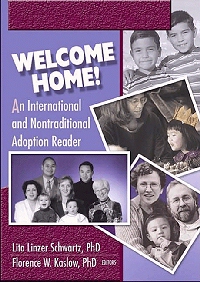
Welcome Home!:
An International and Nontraditional Adoption Reader
Edited by Lita Linzer Schwartz, Ph.D.
and Florence W. Kaslow, Ph.D.
Haworth Clinical Practice Press, 2003
Reviewed by Barbara Free, M.A., LADC, LPCC
After this initial foray into their own research work however, the rest of the book is comprised of first-person stories, mostly by adoptive mothers. In a few cases, the adult adoptee or adult biological offspring added a short piece. In no case was there an open adoption a reunion with birth family, nor any input from any birth parent. Some of the adoptees are still children, mostly from China, although one white woman with several adoptees of African American and/or Haitian background contributed. In all cases the adoptive parents were Anglo and middle-class. Some of the parents are married, some in same-sex relationships, and a few are single parents. There are numerous references by the editors to the Adoption and Safe Families Act of 997 and to the fact that it makes it illegal to consider race in placing children in foster care into adoptive homes. Only after several references to this do they finally mention the Indian Child Welfare Act, which makes placing Native American Children into Native American homes a priority. The editors seem to believe this is a great hindrance, and they repeatedly remark on how important it is to get parental rights terminated as quickly as possible in order to expedite adoption. Birth parents are only referred to in the context of abandoning children, or prenatal drug exposure, or the adoptive parent’s choosing closed international adoptions because they were “more comfortable” with the knowledge that a birth parent would not re-enter the picture, or would never even be identified. In the only story where a birth parent was known (she had personally handed the baby to the adoptive parents in 1962), and the adoptee later found her, and corresponded for a while. The adoptee then decided “my real family are the ones who raised me,” followed by the usual litany about how they had stayed up with her when she was sick, etc. As a reunited birth parent, this writer was appalled to think that someone would go to the trouble to search, even beginning to write and make plans to meet, and then completely withdraw. I can only imagine the birth mother’s sorrow at such a development. The adoptee in question had at one point also ceased all contact with the adoptive parents and had had a child herself at eighteen (which she kept), but whatever the conflict with adoptive family was is glossed over by the adoptive mother and by the adoptee.
Although this book purports to be aimed at a clinical audience—which, one might assume, would mean the authors were objective—their biases come through rather clearly. In the beginning of the book, in discussing the reasons people adopt, they discuss assisted reproduction and mention that it is “against religious law” in several religions, including “several Protestant denominations.” One wonders what that means. Are there religious police to enforce this “religious law”? Then they discuss surrogate parenthood, but comment that Hispanic men would perceive this as a threat to their “machismo.” This comment seems an unnecessary and perhaps incorrect stereotype, especially in what is supposed to be a professional book. The editors further comment that “biology” has so little to do with bonding. It’s the mental commitment you make to another human being. “That, indeed, is what adoption is all about.” One hopes that most adoptive parents today have a better understanding of the birth parent’s importance than that. In one instance, the editors refer to the agency negotiating “the adoption between pregnant female and prospective parents, what legal requirements have to be met, and what costs are involved.” Birth mothers deserve to be referred to as such, not as merely “pregnant females.”
The best story, in this writer’s opinion,. is the one by a single mother who, over a period of several years, adopted four children, one at a time, from China. She seemed to have a good understanding of what each child needed, including the ones with physical disabilities, and the time they needed to become part of her family. She remained in close contact with a support group for families with children from China, and with other single adoptive parents.
In short, we think the book might have been more balanced by including some stories where there was a reunion, or an open adoption, or at least some story from a birth parent’s point of view. In looking at the bibliography at the back of the book, the only books we recognized from the vast array with which we are familiar was Adam Pertman’s Adoption Nation and Jayne Schooler and Betsie Norris’s Journeys After Adoption, both excellent books that offer more balanced information and neither of which the editors, nor any of the contributors to Welcome Home mention in any way. At the conclusion of the book, the editors list five major reasons people adopt from abroad, the last (and apparently most important to them) of which is, “They had a definite preference for a closed adoption, that they would not have to worry that the child’s (children’s) biological parent(s) would resurface to claim the child (children) they had grown to love or that they would encounter other future legal complications.” Few of us wish to be referred to as a “legal complication.”
This book will be in the O.I. lending library. We would welcome comments from others who read it, particularly adoptees and adoptive parents, who each have their own perspectives.
Excerpted from the January 2005 edition of the Operation Identity Newsletter
© 2005 Operation Identity