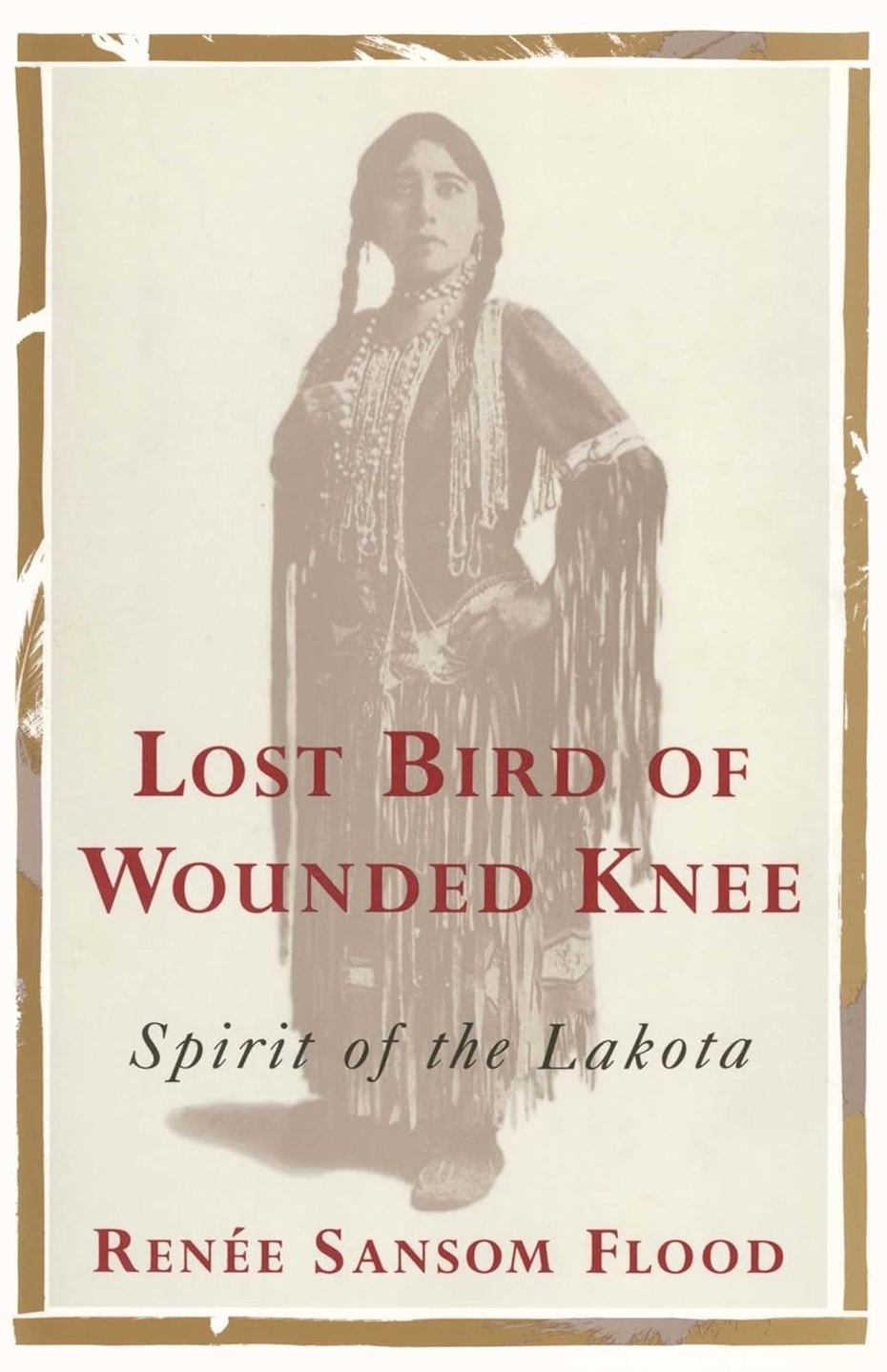
Lost Bird of
Wounded Knee
by Renée Sansome Flood
Scribner, 1995
Reviewed by Barbara Free, M.A.
Four days later, after a blizzard, someone heard the faint cries of a baby. The mother’s body was frozen to the ground in her own blood. This was fourteen years after the Battle of the Little Big Horn, also known as Custer’s Last Stand. The justification for the Wounded Knee Massacre was to kill Sitting Bull and any others who might have survived that infamous battle.
Brigadier General Leonard Colby, who had wanted to be at the Little Big Horn, but was not, saw the surviving infant in January 1891, about two weeks after the massacre, and decided to adopt her, without consulting his wife. He had previously adopted another child, a boy, for her to raise. He saw this as an opportunity to be seen as a hero. He and at least two others, including Buffalo Bill, bargained for the baby, and Colby won. He wanted a real, live souvenir of the Wounded Knee massacre.
His wife, Clara Colby, was stunned when he brought the infant home. She decided to raise her to be a proper white lady! She did, however, name her Zintkala Nuni, meaning Lost Bird, the term still in use today for Native American children adopted by white persons and deprived of knowledge of their original parents’ identities.
The Colbys were living in the small town of Beatrice, Nebraska, at that time. Colby claimed that his grandmother was a full-blooded Seneca Indian. In fact, he had no Native heritage at all. He was always a liar, whether it was about his education, his background, his care for Lost Bird or other children he did father, or his love for his wife, or his many affairs. Later, he swindled many Muscogee, Creek, Cherokee and other Native Americans out of their land and money in Oklahoma. He also sexually abused Lost Bird when she was a young girl, had an affair with a teenaged girl his wife had hired to care for Lost Bird, and eventually married her and tried to get her money, after finally getting a divorce from Clara.
Zintkala Nuni, meanwhile, had developed several physical and emotional problems from growing up in this confusing situation. Colby was often gone, never paid real parental attention to her, and continued to lie about his background, education, and credentials, and did not financially support either his wife or his adopted daughter.
Colby’s wife, Clara, who also had no clue about how to raise a child, was mostly occupied with speaking and writing about women’s suffrage. Susan B. Anthony and Elizabeth Cady Stanton were among her close associates. Anthony thought Clara should just give the child to someone else and concentrate on her work toward getting women’s right to vote.
She spent her own money and nearly starved sometimes, trying to run her newspaper, raise Zintkala as she thought she should in order for her to become a proper lady, and trying to get support from Colby. She was not very successful in any of these efforts, particularly after Zintkala developed serious health problems, as well as mental health issues. She was sent to boarding schools, to Clara’s relatives, and even to institutions for criminally insane girls. No one seemed to recognize the abuse and completely inappropriate treatment to which she was subjected. Her health and her hope for a good life just spiraled down throughout her life. She eventually married, more than once, gave birth to three children, pursued several careers in music and acting, and died at the young age of 29 in 1920.
The last portion of the book concerns the author’s and others’ efforts to bring Lost Bird (Zintkala Nuni) back to the Lakota Reservation and have a ceremony for her return and reburial. The Prologue and the Epilogue to the book concern these events, and are the most uplifting portions of the book.
The entire book, however stressful it is to read, accurately portrays her difficult life, and parallels many other adopted Native Americans’ lives, although her suffering was more extreme than most. In the current era, adoptive parents, laws, and attitudes are more enlightened. The Indian Child Welfare Act helped many, but was still being abused and ignored for many years, and some of those children, as adults, were clients I worked with as an addiction therapist. I thought of them often as I read this book, and hoped they had better adult lives as they were able to embrace their full heritages.
This book was so moving I ordered three more copies from Thriftbooks to give to friends I knew would want to read it. I wish Zintkala Nuni could have written her own story for all to read, but Renée Sansome Flood, the author of Lost Bird of Wounded Knee, did a wonderful job in her memory.
Excerpted from the February 2026 edition of the Operation Identity Newsletter
© 2026 Operation Identity