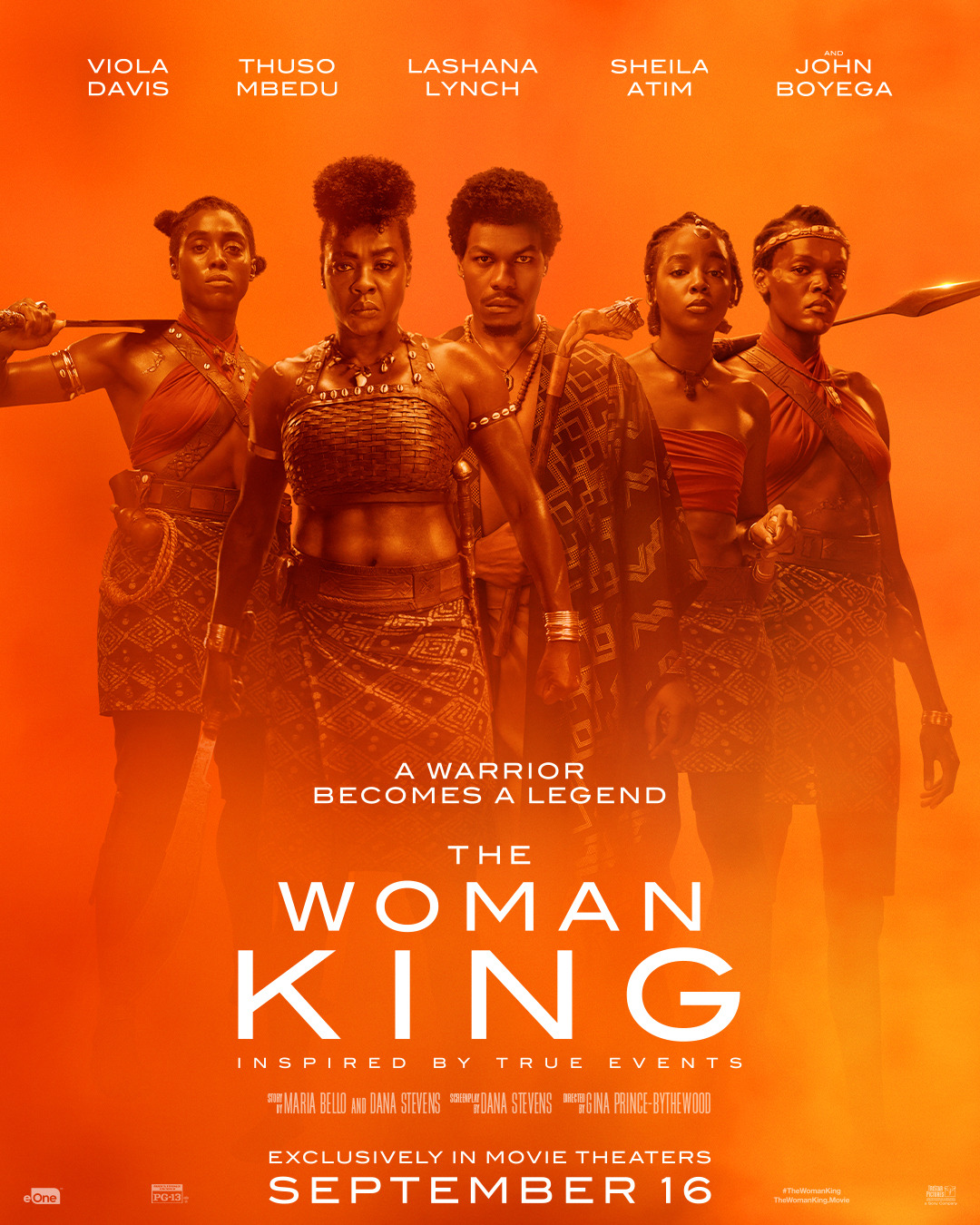
The Woman King
Screenplay by Dana Stevens
Directed by Gina Prince-Bythewood
Starring Viola Davis, Thuso Mbedu, Lashana
Lynch, Sheila Atim, and John Boyega
Released September 16, 2022
Distributed by Sony Pictures Releasing
Reviewed by Amy Butel
Having only seen a small number of films set in Africa (Out of Africa; Mandela; Hotel Rwanda; The African Queen and The Gods Must Be Crazy), I found The Woman King to be as riveting as the other films that I’d seen from the continent, but taking place in a very different time and very different place. Africa is three times the size of the U.S., the second largest continent and made up of many diverse ecosystems. The Woman King is set in the West African Kingdom of Dahomey, in what is now the country of Benin, during times of war with neighboring nations two hundred years ago, towards the end of the three centuries of transatlantic slave trade.
The film is an historical epic, according to the Director Gina Prince-Bythewood, not a documentary. However she was adopted as a child and used her own experience of being adopted to inform the adoption story in the film. The Lead Actor and Producer, Viola Davis, is also an adoptive mother in addition to being a stepmother. The adoption element of the story seems to be told with sensitivity to the tragedy and complexity of relinquishment as well as reunion.
It is apparent that the film was inspired by and largely created by both women and people of color, compared to typical Hollywood films. The stunning use of dance, song, music, costume and makeup in addition to the violence of the time to bring one to this place and to feel viscerally the complexity and danger as well as brilliance and heroism of the previously little known women warriors known as Agojie, whose leader in the film, Nanisca, becomes the Woman King.
I was very interested in pursuing the facts from the period after watching it, as there are elements of historical inaccuracy in addition to accurate historical detail. There are extensive bibliographies online by searching “woman king syllabus,” where scholarly writing on many subjects related to the film may be viewed through links, directly on the site, or found in library collections. National Geographic published an article about the Agojie the same week that the film was released.
The adoption story is fictional, but draws the two main characters together and the story is one of powerful women in community, with less powerful, or really traumatic pasts that might be circumstances that those with adoption connections could relate to. The reunion in the film is unintended or by accident and so more dramatic but not too realistic compared to real world reunions. But the warrior connection that brings them together is so appropriate and so sweet. Their command of combat does not take away, but strengthens their humanity in having a direct hereditary connection. The film is also a joyous tribute to a real story of community, support and engagement, which is what Operation Identity strives to provide for members and the larger community.
Another film by the same director with searching-for-family themes that I also recommend is The Secret Lives of Bees. Reading the book was very powerful for me and the film adaption was an excellent one. Both films are available to rent from my local library and through online streaming.
The Woman King is available to stream on HBO Max or Disney+.
Published in the November 2025 edition of the Operation Identity Newsletter
© 2025 Operation Identity